Saturday, 15 October 2011

Briefly It Enters, Briefly It Speaks by Jane Kenyon

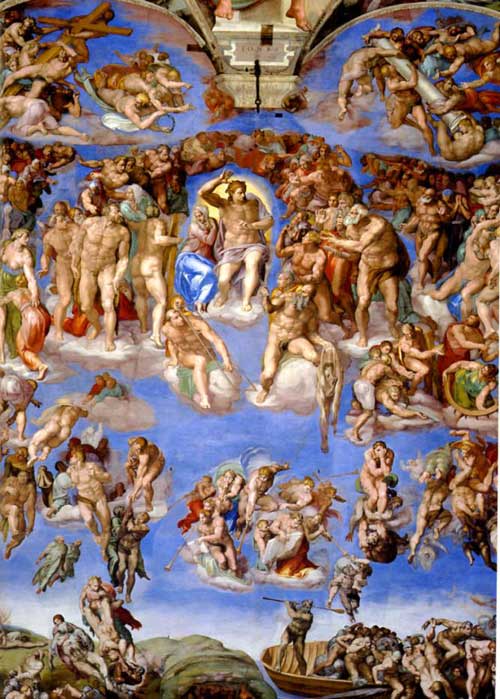
I'd never heard of Jane Kenyon until last week and I've already decided to do everything in my power to look like her. This is a beautifully simple poem that's probably about God. Funny how that put me off at first - until I realised how hypocritical I was being, considering I have a poster of The Last Judgement on my bedroom wall.


Briefly It Enters, Briefly It Speaks

I am the blossom pressed in a book,
found again after two hundred years. . . .

I am the maker, the lover, and the keeper....

When the young girl who starves
sits down to a table
she will sit beside me. . . .

I am food on the prisoner's plate. . . .

I am water rushing to the wellhead,
filling the pitcher until it spills. . . .

I am the patient gardener
of the dry and weedy garden. . . .

I am the stone step,
the latch, and the working hinge. . . .

I am the heart contracted by joy. . . .
the longest hair, white
before the rest. . . .

I am there in the basket of fruit
presented to the widow. . . .

I am the musk rose opening
unattended, the fern on the boggy summit. . . .

I am the one whose love
overcomes you, already with you
when you think to call my name. . . .

Jane Kenyon

Wednesday, 12 October 2011

Brideshead Revisited by Evelyn Waugh

I don’t care if Evelyn Waugh lived a century ago, I WANT HIM TO BE MY FRIEND.


Five Points About This Book Which I Thought Of And Wrote:


1. The Characters

The novel opens as Captain Charles Ryder, after stumbling across a stately home in war torn England, begins to reminisce about the two most important people in his life: Sebastian and Julia Flyte. So begins the “revisiting” referred to in the title, and one of the funniest, most heartbreaking and poignant stories you will ever read.
Beginning with his university days, Charles is taken on a journey of debauchery and “naughtiness” by teddy-bear holding, atheist socialite Sebastian, introducing Charles to his home at Brideshead and his religion obsessed family. Sebastian is a complete personification of the Roaring Twenties spirit; frivolous, extravagant and ultimately, doomed.
Charles semi-infatuation with Sebastion occupies the first half of the book, whilst the second half focuses on his love for Sebastian’s equally profound and religiously confused sister Julia. The thing is, Waugh writes so BLOODY beautifully that you cant help but fall in love with these characters yourself, sharing Charles dizzying highs and pathetic lows with the two.

2. The Writing

Sometimes Waugh writes so well that I don’t even realise until I’m making dinner several hours later, shout “wait – what did he say?” and rush off to check while my macaroni cheese foams over the sides of the saucepan.
Take a read this passage to understand what I’m talking about:

This was the creature, neither child nor woman, that drove me through the dusk that summer evening, untroubled by love, taken aback by the power of her own beauty, hesitating on the cool edge of life; one who had suddenly found herself armed unawares; the heroine of a fairy story turning over in her hands the magic ring; she only had to stroke it with her fingertips and whisper the charmed word, for the earth to open at her feet and belch forth her titanic serpent, the fawning monster who would bring her whatever she asked, but bring it, perhaps, in unwelcome shape.

Yes, that is one sentence. Now go and make some macaroni cheese.

3. The Comedy

Imagine two Oxbridge students from the1930s, add champagne, strawberries, frivolity and homoeroticism and you get a flavour of the humour of this novel. Waugh writes with a biting wit, so caustic that it could burn a hole through the page, expressing great disdain through his characters for the multitude of well-to-do stereotypes that inhabited that particular era.
My favourite comedy scenes though involved Charles and Sebastian, who spend much of their time inebriated and carefree, talking about “rot” and “getting tight”; only occasionally reflecting on their behaviour as in this passage which made me cackle like a mad witch on the tube:

“Ought we to be drunk every night?” asked Sebastian one morning.
“Yes, I think so.”
“I think so too”.


Oh Sebastian and Charles, I want to be in your gang.

4. The Tragedy

The triviality eventually fades away though, and the second half of the novel becomes a lot more introspective, examining the nature of addiction, religion and love. At the risk of giving anything away, I wont delve too deep but rest assured that even when Waugh writes tragedy, it’s never melodramatic. Everything is contained, bubbling under the surface. Charles’ infatuations shift from Sebastian to Julia, but it is really the Flyte family and the world they inhabit, Brideshead, that ultimately captures him and causes him to reminisce so vividly.
The real sucker punch is this – the biggest spoiler of Brideshead Revisited is on page one. Charles is a lonely soldier, and encounters Brideshead again completely by chance. I don’t need to tell you how his relationships with Julia and Sebastian turn out; the inevitable destruction of each character is really at the tragic centre of the novel.

5. The Relevance

Perhaps the aspect I enjoyed most about Brideshead Revisited was how many times I found myself thinking “good grief, that is so true”. I felt this especially when Charles described his experiences at University; he is told calmly that “you’ll find you spend half of your second year shaking off the undesirable friends you made in the first” (unbelievably true) and particularly when he thinks that “if I was not going to take up one of the professions where a degree is necessary, it might be best to start now on what I intend doing” (it has occasionally struck me that I ought to start on that novel I’ve been planning since I was fifteen – my degree in philosophy was rendered useless the day I discovered “Philosopher” isn’t an actual career).
Not only this, but the observations he makes about society and social niceties completely spot on.This is a remarkable achievement, considering that the novel was written 80 YEARS AGO. Evelyn Waugh could be transported into the here and now and feel perfectly at home – once he gets used to touchscreens and unexpected items in the bagging area.

Put quite simply, this novel is a masterpiece. Anybody with even a passing interest in literature should consider this a must read.

8.5/10

Monday, 10 October 2011

Genius by Mark Twain

It's days when your bank makes you wait for 35 minutes for no reason on your lunch break and the wind blows your skirt up just as a group of five teenage boys walks past, that you wish you looked more like Mark Twain. That moustache does not take shit from anybody.


Genius

Genius, like gold and precious stones,
is chiefly prized because of its rarity.

Geniuses are people who dash of weird, wild,
incomprehensible poems with astonishing facility,
and get booming drunk and sleep in the gutter.

Genius elevates its possessor to ineffable spheres
far above the vulgar world and fills his soul
with regal contempt for the gross and sordid things of earth.

It is probably on account of this
that people who have genius
do not pay their board, as a general thing.

Geniuses are very singular.

If you see a young man who has frowsy hair
and distraught look, and affects eccentricity in dress,
you may set him down for a genius.

If he sings about the degeneracy of a world
which courts vulgar opulence
and neglects brains,
he is undoubtedly a genius.

If he is too proud to accept assistance,
and spurns it with a lordly air
at the very same time
that he knows he can't make a living to save his life,
he is most certainly a genius.

If he hangs on and sticks to poetry,
notwithstanding sawing wood comes handier to him,
he is a true genius.

If he throws away every opportunity in life
and crushes the affection and the patience of his friends
and then protests in sickly rhymes of his hard lot,
and finally persists,
in spite of the sound advice of persons who have got sense
but not any genius,
persists in going up some infamous back alley
dying in rags and dirt,
he is beyond all question a genius.

But above all things,
to deftly throw the incoherent ravings of insanity into verse
and then rush off and get booming drunk,
is the surest of all the different signs
of genius.

Friday, 30 September 2011

General End Of Month Update

I haven't read as many books as I would've like this month, but the sheer super quality of the books I have read more than makes up for this. They are:

One Day by David Nicholls (this book DESTROYED me emotionally. Oh Nicholls, you build us up just to bring us down again, just like the irksome buttercup from that popular song)

The Wind Up Bird Chronice by Haruki Murakami (come and live in London, Murakami, so that I may befriend and subsequently wed you)

Brideshead Revisited by Evelyn Waugh (Just. Superb. Review will come imminently because I need to rave about this book to somebody other than my bathroom mirror)

This weekend I will be off round London to search for books as part of the Guardian Book Swap, pretending to be some kind of manic pixie dream girl.

Sunday, 25 September 2011

Phenomenal Woman by Maya Angelou

The first time I heard this poem was when a lady in a coffee shop in Liverpool played the AMAZING acoustic version (below) that made me feel inexplicably good about myself. I think it's because insecurity has grown to annoy me - there's something sort of vaguely attention seeking and depressing and boring about it. What's refreshing is when people accept their flaws and either try to change them or flaunt them, which is exactly what Maya Angelou does in this poem. Fantastic.


Phenomenal Woman

Pretty women wonder where my secret lies.
I'm not cute or built to suit a fashion model's size
But when I start to tell them,
They think I'm telling lies.
I say,
It's in the reach of my arms
The span of my hips,
The stride of my step,
The curl of my lips.
I'm a woman
Phenomenally.
Phenomenal woman,
That's me.

I walk into a room
Just as cool as you please,
And to a man,
The fellows stand or
Fall down on their knees.
Then they swarm around me,
A hive of honey bees.
I say,
It's the fire in my eyes,
And the flash of my teeth,
The swing in my waist,
And the joy in my feet.
I'm a woman
Phenomenally.
Phenomenal woman,
That's me.

Men themselves have wondered
What they see in me.
They try so much
But they can't touch
My inner mystery.
When I try to show them
They say they still can't see.
I say,
It's in the arch of my back,
The sun of my smile,
The ride of my breasts,
The grace of my style.
I'm a woman

Phenomenally.
Phenomenal woman,
That's me.

Now you understand
Just why my head's not bowed.
I don't shout or jump about
Or have to talk real loud.
When you see me passing
It ought to make you proud.
I say,
It's in the click of my heels,
The bend of my hair,
the palm of my hand,
The need of my care,
'Cause I'm a woman
Phenomenally.
Phenomenal woman,
That's me.

Maya Angelou

Thursday, 22 September 2011

For a Fatherless Son by Slyvia Plath

Here is a sad poem - I'm not sure why, as I'm in an uncharacteristically good mood today. It's also by Sylvia Plath, whose poetry I'm generally not crazy about. Good old Sylv wouldn't know a good mood if it smacked her in the face and in tribute to her misery and seriousness, here is a little ditty from "Winter Trees".


For a Fatherless Son

You will be aware of an absence, presently,
Growing beside you, like a tree,
A death tree, color gone, an Australian gum tree ---
Balding, gelded by lightning--an illusion,
And a sky like a pig's backside, an utter lack of attention.
But right now you are dumb.
And I love your stupidity,
The blind mirror of it. I look in
And find no face but my own, and you think that's funny.
It is good for me
To have you grab my nose, a ladder rung.
One day you may touch what's wrong ---
The small skulls, the smashed blue hills, the godawful hush.
Till then your smiles are found money.

Slyvia Plath